How Indonesian Artisans Make a Terracotta Planter: From Raw Material to Finished Piece
Understanding the actual process behind a terracotta planter — from raw clay through to a finished, fired piece — helps explain both its price and the natural variation buyers should expect in every batch. Here’s how it comes together.
Quick Answer
Production starts with clay preparation — sourcing, cleaning, and kneading the clay to remove air pockets and achieve a workable consistency.
Shaping is typically done by hand or on a potter’s wheel, depending on the design, with skilled artisans working largely from experience rather than rigid moulds.
Pieces are dried slowly before firing to avoid cracking, then fired in a kiln at high temperature to achieve their final hardness and colour.
Finishing — glazing, sanding, or leaving a piece unglazed — happens after firing, and is where much of the visual character of the final piece is set.
Step One: Sourcing and Preparing the Clay
The process begins with sourcing suitable clay, typically from local deposits known to the pottery community for their workability and firing characteristics. Raw clay is cleaned of stones and debris, then kneaded thoroughly — a process sometimes called wedging — to remove trapped air pockets and achieve an even, workable consistency throughout. Air pockets left in the clay can cause a piece to crack or even fracture during firing, so this preparation stage, while unglamorous, is one of the most important for quality.
Step Two: Shaping the Piece
Depending on the design, a planter may be shaped by hand-building — coiling or pinching clay into form — or thrown on a potter’s wheel, where a skilled artisan shapes rotating clay into a symmetrical form using hand pressure and simple tools. Larger or more sculptural pieces often combine both techniques, with a wheel-thrown base built up or altered by hand afterward. This is where an artisan’s experience shows most clearly: consistent wall thickness, an even base, and a clean rim all depend on hand skill built up over years of practice, and small variations between individual pieces are a natural result of this hand process rather than a defect.
Step Three: Drying Slowly and Carefully
Before firing, a shaped piece needs to dry slowly and evenly to what’s known as the “leather-hard” stage, and then further to fully dry, before it can safely go into a kiln. Drying too quickly, or unevenly, can cause warping or cracking, so this stage often takes place in a shaded, ventilated area over several days depending on humidity and the size of the piece. This is one of the reasons terracotta production can’t be meaningfully rushed — the clay itself sets the pace.
Step Four: Firing in the Kiln
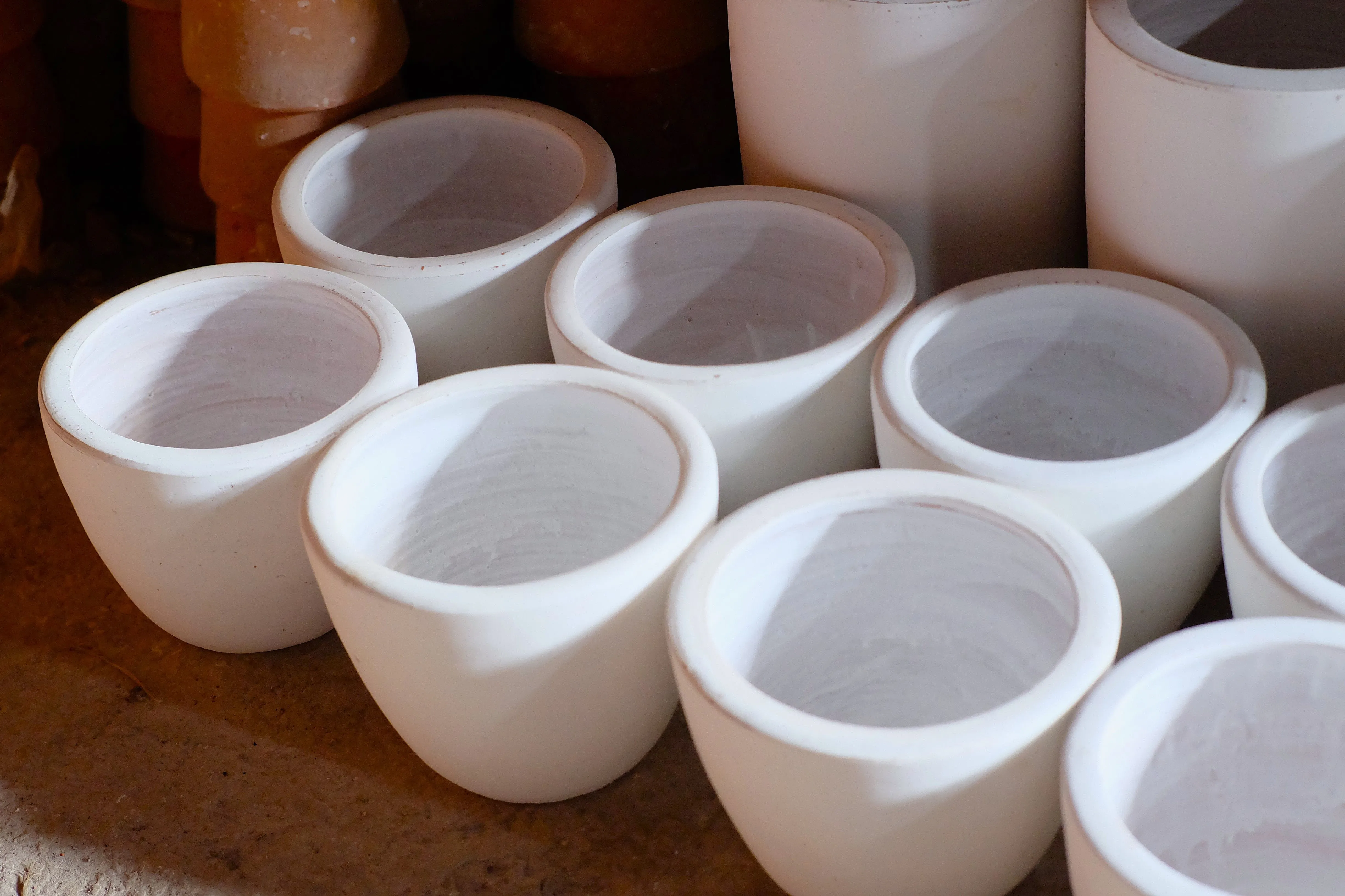
Firing is what transforms soft, dry clay into hard, durable terracotta, typically at temperatures reaching several hundred degrees Celsius over a sustained firing cycle. This is also where terracotta gets its characteristic warm reddish-orange colour, a direct result of iron oxide in the clay reacting during firing — meaning the colour is intrinsic to the material itself, not an applied finish. Kiln firing is done in batches, which is part of why category-level minimum order quantities exist: a firing run needs enough pieces to be worth the fuel and time investment, and workshops plan batches accordingly.
Step Five: Finishing
After firing, a piece may be left unglazed to show its natural clay texture and tone, lightly glazed to add subtle sheen while keeping texture visible, or fully glazed for a smoother, more uniform, and easier-to-clean surface. As covered in our piece on terracotta in interior design, unglazed and lightly glazed finishes are currently the stronger sellers, reflecting demand for visible natural texture over uniform gloss.
Why This Process Explains What Buyers See in a Batch
Because each piece passes through hand-shaping, natural drying, and batch firing, some variation between individual pieces within an order is normal and expected — slight differences in size, subtle tonal variation from firing, and small asymmetries from hand-shaping are all hallmarks of genuine handmade terracotta rather than manufacturing defects. Buyers new to this category sometimes expect factory-level uniformity; setting that expectation correctly with retail customers, or choosing product photography and descriptions that embrace this variation, tends to work better than presenting terracotta as if it should look identical piece to piece.
Understanding this production process also connects to the wider supply chain covered in our piece on how artisan villages work from workshop to warehouse, including how quality is checked at each stage before a finished piece is packed for export.
Bali Bhumi sources terracotta direct from artisan potters in Java working with these traditional hand-shaping and kiln-firing techniques.Get in touch to discuss your range, or browse our terracotta catalogue.